Friday, May 13, 2022

Did NEPSE change its minor trend from bearish to bullish??

No, still there is conformation pending for NEPSE to called its minor trend as bullish. Though the quick trade was possible after NEPSE formed a perfect hammer candle stick pattern on 8th may in a daily time frame followed by w pattern break out on 9th may at 12 p.m. in an hourly basis candle but we should also keep in mind that lower the time frame higher the chances of false signal.


Market is said to be in bullish until and unless market makes the series of higher high and higher low which is still pending in the market.


For market to change its trend from bearish to bullish in a minor trend market need to protects 2200 level for now and should make series of higher high and higher low.

BANKING INDEX 
Banking index alone holds around 36% of weightage in NEPSE which means it has higher impact on NEPSE. Banking index formed an engulfing candle stick pattern on weekly time frame which indicates the reversal in the market but candlestick alone cannot determine the reversal in the market, volume also plays an important role. Volume is slightly greater in banking index compared to last week but its below 20-day average volume.


What next now? 
Whoever looking for taking new position enter on breakout of 2390-2400 stop loss being at swing low for now i.e., is currently 2200.


Thursday, February 17, 2022

Strategies for Stock Trading: Averaging Down or Pyramiding?


Averaging down means buying more of a stock as its price falls, aiming to lower the average cost. This is done to reduce the weighted average cost of capital (WACC). On the other hand, pyramiding involves adding to a position as prices rise, also known as averaging up. The key is to start a position, make incremental purchases in a downtrend (averaging down), or in an uptrend (averaging up) until a set limit or a maximum investment is reached. 


However, many people make the mistake of averaging down when prices are falling, going against the trend. It's crucial to follow the trend, as the saying goes, "the trend is your friend." Buying when prices are decreasing increases the risk of losses because there's no certainty that the price will turn around. Instead, it's better to buy when prices are increasing, following the trend, even if it goes against the notion of buying low and selling high. 


People often fear buying stocks when prices are rising due to the fear of a potential fall. However, buying high and selling higher can be a successful strategy. The key is not to trade against the trend. Pyramiding works well in a trending market, but identifying the right points to add to a position can be challenging. 


Averaging down can lead to greater profits in certain circumstances, but it's essential to distinguish between a stock's individual event and a broader market correction. For this strategy to work, the company should have good performance, minimal debt, and a growing cash flow. 


Ultimately, once in a trade, if it moves in your favor, the probability of success is higher, while immediate movement against you increases the likelihood of failure.

Friday, February 11, 2022

Is Stock Market Investing a Zero-Sum Game?

We often hear that the stock market is a zero-sum game and that makes sense at first glance. If someone makes money in the stock market, does that means someone else is going to lose money? So, the question immediately arises, is the stock market really a zero-sum game?


What is a zero-sum game?

A zero-sum game is a situation where one's profit equals one's loss, so the difference in wealth is zero. So, if you and your friend bet on a coin toss, it becomes a zero-sum game. If you win, your friend loses, and if you lose, your friend wins. Some well-known examples of zero sum games are poker and gambling. The same can be said about casinos and gamblers. If the casino wins, the players lose, and if the player wins, the casino loses. The name "zero-sum" games reflect the fact that if the winner's earnings were added to the loser's losses, the total would equal zero at the end of the game. As a result, one of the distinguishing characteristics of a zero-sum game is that someone must lose in order for someone to win.

Is stock market investing a Zero-sum game?

When it comes to the stock market, the vast majority believes it is a zero-sum game. After all, money earned by someone must come from somewhere, and most people feel it comes from the other loser. However, this is not true. Investing in stock can be mutually beneficial. Because of the varied risk tolerances of the participants, trades in the stock market are dependent on future expectations. Someone selling his stock does not necessarily indicate he is losing money. He might have made a lot of money and was eager to book it. Similarly, if one investor sells, there's no reason to believe the next investment won't profit as well. Both parties have a chance to win in this situation.

Let’s take few real-life example:

Mr. X bought a stock of XYZ company when it was trading at 500 rupees. When the stock ran up to 1000, he decided to sell his shares and the buyer of those shares was Mr. Y. Now, Mr. Y was just as patient as Mr. X and saw XYZ’s shares soaring to 1500 rupees. So, he decides to sell the shares at 1500 rupees. And this goes on and on.

So, in this story, who’s the loser? Well, nobody. Everybody is a winner in this stock as long as XYZ’s growth story continues.

Overall, a zero-sum game isn’t the right description of investing. As the company expands and becomes more valuable, the stock market can increase the wealth of both the participants & economy over time.Dividends are an essential component that is frequently overlooked when viewing the stock market as a zero-sum game. Corporations earn profits from sales and distribute a portion of those profits to shareholders in the form of dividends. If the market were a closed system with only buyers and sellers, it might be thought of as a zero-sum game. It is not, however, a closed system because firms continue to pour money into it as dividends. The classic mistake people make is that they think that shares of a company are just the same as a coin in the coin toss or those chips in the casinos and that’s where the whole confusion starts. The reality is that a company’s stock is very much a living, breathing entity. It can bring more money in the market or it can suck money from the market depending on the company’s financial performance.

So, the answer is no. The stock market is not a zero-sum game. It can be a positive-sum game for investors of good stocks and a negative-sum game for investors of bad stocks. 

There is a zero-sum game also in the stock market and that is in derivatives, i.e., futures and options.


Wednesday, January 19, 2022

LIST OF IPOs ISSUED IN 2021 AND THEIR VALUES AT THE END OF 2021

Altogether 19 companies issued IPO and traded in 2021.Among 19 listed companies, NIFRA applicant got minimum 50 units and remaining applicant got only 10 units on lottery basis. The list of 19 companies with the initial investment amount and their values at the end of 2021 are mentioned below:


If we had been allotted every IPOs then the worth at the end of 2021 would be Rs 1,98,012 with an initial investment of Rs 23000 which is 760.92 % in return. PS All applicant were not allotted with every IPOs.I personally got allotted 9 IPOs using 4 demat account of my family members and it’s worth at the end of the year 2021 is Rs 90,312 with an initial investment of Rs13,000 which is 594.71% in return.


START INVESTING RATHER THAN REGRETTING


Thursday, December 30, 2021

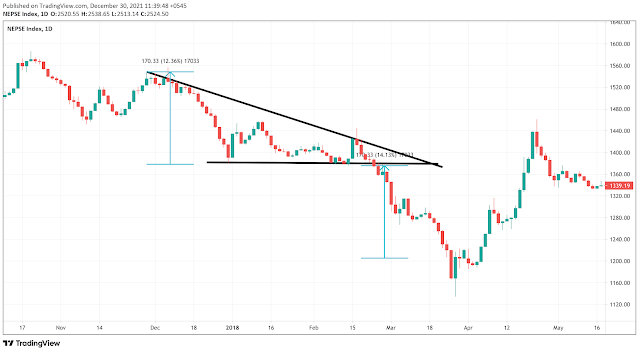
Back testing NEPSE with the Technical Analysis Chart Patterns!!

There is big controversy going around that technical analysis doesn't work on NEPSE so here I did some back testing on NEPSE index before that let's see what is technical analysis and its accuracy in the market.

What is Technical Analysis?

Basically, Technical analysis refers to the analysis of stock market using different chart patterns, volume and indicators. There are generally three assumptions:

1) Market discounts everything

2) Price moves in a trend

3) History trends to repeat itself

Is technical analysis 100% accurate?   

No, technical analysis is not 100% accurate. Not even fundamental analysis is 100% accurate. No one can predict the market 100%. Almost around 70% accuracy of technical analysis is expected.

Back testing of NEPSE index

This testing was done surfacy in NEPSE index and this does not mean that every chart patterns here gives 100% result. Most of the time chart patterns do fail and stop loss is hit but if you are able manage your risk to reward ratio there is always a win win situation in the market. There are few charts pattern I picked up from NEPSE index:

Here expectation refers to the example from the web and reality refers to how beautifully NEPSE index follows technical analysis chart pattern.

1) Symmetrical Triangle pattern

Expectation


Reality


2)Descending Triangle pattern


Expectation


Reality


3) Head and Shoulder


Expectation


Reality


4) M pattern


Expectation

Reality


5) W pattern


Expectation


Reality


6) Rounding Bottom pattern


Expectation


Reality


You just need skills to identify the chart patterns correctly and some confidence in yourself.


Saturday, August 28, 2021

Why traders need to book profit?

On 27 July 2021, NEPSE index opened at 3030.51 and closed at 3079.67 with 29.24 (0.96%) points gain. NEPSE took 17 trading days dated from 27th July to 19 August, 2021 to gain 159.23 (5.19%) point. But it took only 3 trading days dated 19th August to 25th August to wipe all your profit that you earned from the last 17 days. Yes, we are in the bull run NEPSE is still expected to go further high but on the other side no one can predict Mr. market and things does not go always expected. So, make the habit of booking your profit. This strategy might not help to make enough out of this bull run but surely it will help you not to lose your profit that you have been making in this bull run and this strategy will surely be profitable to you when the market will be bearish. 


Wednesday, April 14, 2021

WHAT IF 90's CHILDREN HAD INVESTED IN STOCK MARKET IN NEPAL AT THE AGE OF 20?


People who were born around 1986-1996 are known as 90's kids. In 2016, people born in 1996 turned 20 in. Let's see what if they had invested in the Nepalese stock market then would be like.

Here is the growth of NEPSE with some of the popular index of Nepalese stock market from 2016/01/01 to 2021/04/13.


Nepse


NEPSE had a growth of around 135% from 2016 till now.

Banking


Banking sector had a growth of around 80% from 2016 till now.

Microfinance


Microfinance sector had a growth of around 190% from Nov 2017 till now. 
    

Life Insurance


Life Insurance sector had a growth of around 185% from 2018 till now.

Non-Life Insurance


Non-Life Insurance sector had a growth of around 132% from July 2018 till now.


Now, let's see what if we had invested Rs 1000 each in the above sector in 2016  assuming that the stock is sold every year and the return is utilized for 5 year i.e. compounding effect.


We could have made 3.5 times more than the initial investment amount.

* This is just a tentative figure. Here in Nepal, we cannot invest in indices and we might not get return while calculating on individual stock.

** Investment/Trading in securities Market is subject to market risk, past performance is not a guarantee of future performance.